
Butler County Health has participated in the Medicare Swing Bed Program since it was first authorized in 1980. Over time, the term “Swing Bed” has often caused confusion for patients. To provide greater clarity, Butler County Health now refers to this service as the Transitional Rehabilitation Program.
The Transitional Rehabilitation Program serves as the next step following an acute inpatient hospitalization and can be an alternative to skilled nursing facility placement for patients who are not yet ready to return home. The term “transitional rehabilitation” reflects the change in level of care patients receive once they no longer require acute hospital services. Admissions to the program are intended for patients who still require skilled nursing care and/or rehabilitation services as determined by their physician. These services may include physical therapy, occupational therapy, speech therapy, wound care, IV therapy, and other specialized care. To qualify, patients must have an acute care stay that included at least three overnights.
“Patients who return home following a short-term acute hospitalization and later experience challenges that require additional care may be eligible for transitional rehabilitation services, even without another three-night hospital stay,” explained Kelli Stara, Social Services Coordinator. “Eligibility is based on individual circumstances, including insurance coverage and Medicare guidelines, but our team is here to help patients understand their options and navigate the process.”
While acute care is designed to treat illness or injury, the Transitional Rehabilitation Program is designed to help patients recover and prepare for their return home. “This ensures continuity of care, as patients continue receiving support from the same nurses, physicians and therapists who cared for them during their acute stay at Butler County Health. It also allows individuals who received acute care at other facilities, such as Bryan Health or UNMC, to return to Butler County Health for their recovery,” explains Kristin Hartman, RN, Director of Nurses. Patients who may benefit from the program include those recovering from surgery, accidents or injuries, stroke recovery, respiratory illnesses such as pneumonia or COPD, chronic condition reconditioning, wound care, pain management or long-term IV therapy.
One patient and wife shared their experience with the program. “I brought my husband, Dwight, to the ER at Butler County Health with stroke-like symptoms. Due to the severity, and the fact that it was his eighth stroke, he was transferred to Lincoln,” explained Jeanne Rasp. “After Bryan Health, we transferred Dwight back to Butler County Health for the Transitional Rehabilitation Program. It was so convenient having him cared for close to home so I could continue managing things at home and see him regularly. If he had stayed in Lincoln, I would not have been able to visit him as often.”
Jeanne also shared that during Dwight’s stay, staff assisted with bathing, dressing and feeding, making the caregiving experience easier for her. He received physical, occupational and speech therapy three to five times per week, up to three times daily. Dwight and Jeanne also participated in care staff meetings with his physician, Dr. Daro, nursing staff and therapy teams. These meetings reviewed his progress, discussed goals and helped determine when he could safely transition home.
The Transitional Rehabilitation Program is not intended for permanent placement. The length of stay in the Transitional Rehabilitation Program is dependent upon each individual patient. Medicare does allow a Transitional Rehabilitation Program stay for up to 100 days; however, most stays are less than 30 days.
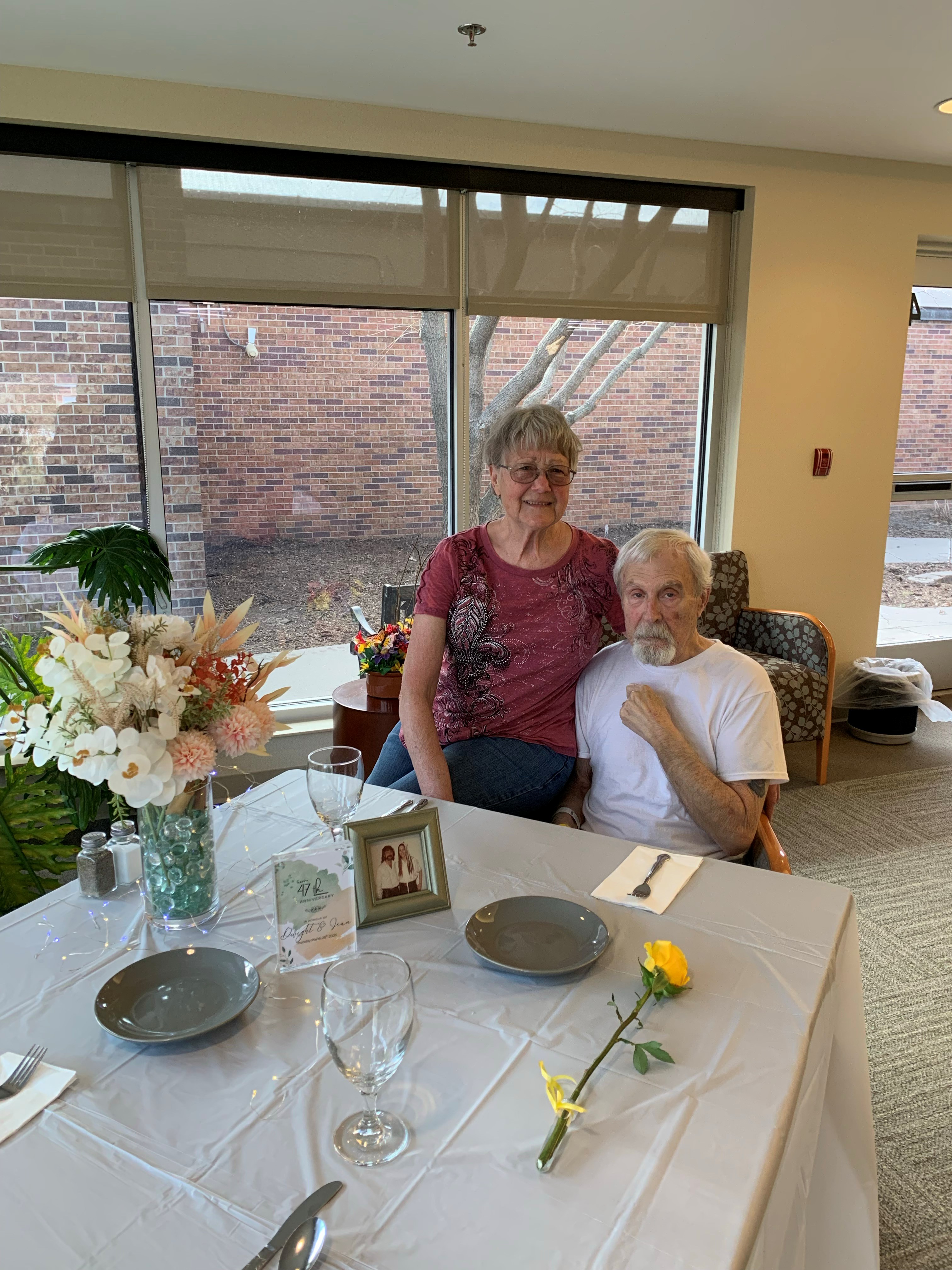
“Dwight stayed for 21 days at Butler County Health. During that time was our 47th Wedding Anniversary,” explained Jeanne. “Dwight called me that evening and invited me to supper at the hospital. When I arrived, I was surprised to find a table set in the sunroom with twinkling lights, flowers and a catered dinner from Northside. The staff went above and beyond to make our anniversary so special,” she said.
“When Dwight mentioned that his wedding anniversary was approaching, our team immediately came together to create a meaningful celebration. Staff from therapy, nursing and marketing collaborated to plan a special evening, gathering some of Jeanne’s favorite things with Dwight’s guidance,” explained Hannah Wurl, Occupational Therapist.
“The excitement was evident when he called Jeanne to invite her to dinner, and her joyful response made the effort even more worthwhile. Helping the Rasp’s celebrate their 47th wedding anniversary during Dwight’s stay was a powerful reminder that BCH care extends beyond rehabilitation. This experience was about preserving meaningful roles, honoring relationships and creating moments that bring comfort and purpose,” Hannah added. Celebrating Jeanne and Dwight’s years together brought joy, normalcy and connection during a challenging time, reinforcing the importance of person-centered care in our rural community.
Eligibility in the Transitional Rehabilitation Program is evaluated on a constant basis, as the patient must be making progress in order to qualify for transitional rehabilitation status. The skilled nursing care provided by the Transitional Rehabilitation Program is generally paid for by Medicare or Medicaid or by private insurance carriers. Medicare will cover up to 20 days at 100% for skilled nursing care at the hospital. After the first 20 days, if the patient continues to qualify for skilled care services, they are responsible for daily coinsurance up to the 100th day, the same as in a nursing home facility. Sometimes patients may experience a break in care which may change their eligibility for coverage. For example, if a patient leaves the skilled services for less than 30 days and then needs to return to skilled care for the same medical condition, they will not need another three day hospital stay to be eligible for skilled care coverage. If the break lasts for 60 consecutive days, the skilled benefits will be renewed for transitional rehabilitation only if another three day hospital stay occurs.
“We had the option to be transferred to Madonna, but we chose to stay close to home with our provider, Dr. Daro, and the staff at Butler County Health who know us and care for us,” Jeanne said. Dwight added, “It’s like a family at Butler County Health; it’s really like being with family.”
The primary objective of the Transitional Rehabilitation Program is to provide patients and their families with extraordinary care and assist them in achieving their goals. Butler County Health strives to get you back home in a timely manner by providing exceptional health care and service. For more information about our Transitional Rehabilitation Program please contact us at 402-367-1200.